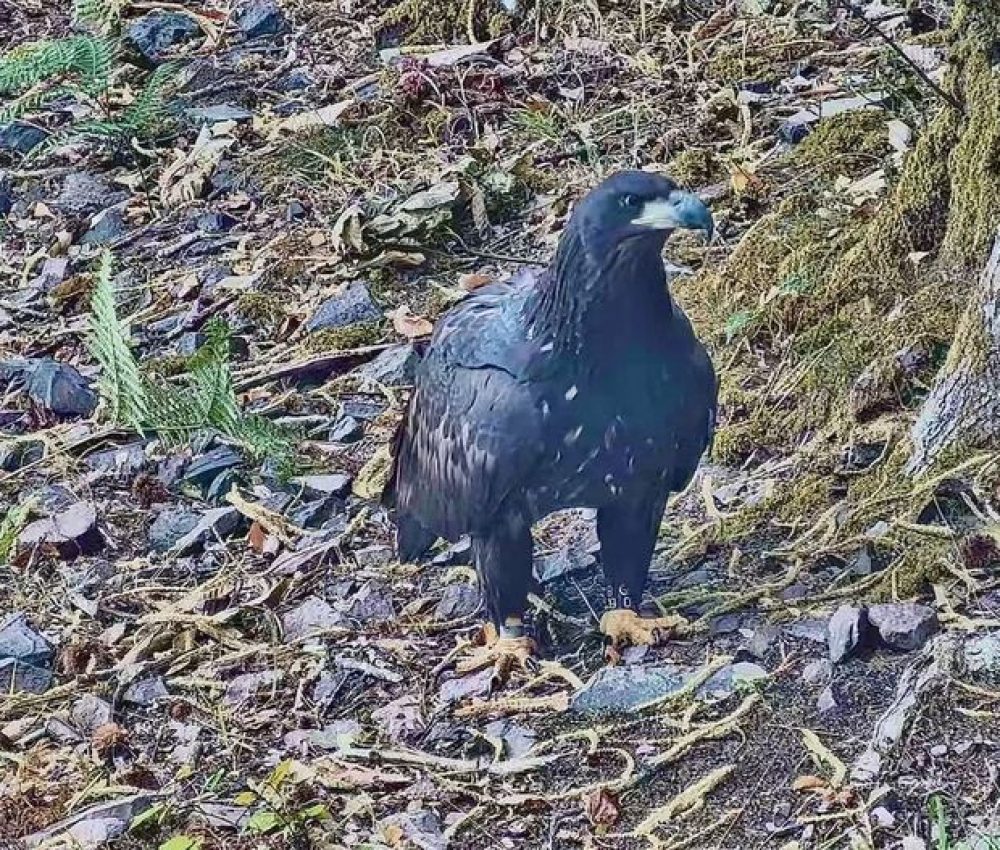

Golden eagles were hunted and poisoned out of England and Wales by the mid-nineteenth century and are now maintaining only a tenuous hold over the mountainous areas of highland Scotland. In Europe, they are found in the Pyrenees, the Alps and the Massif Central as well as in Scandinavia and areas of eastern Europe. All very far removed from here.
So to find an account of a sighting on Exmoor whilst I was reading E. W. Hendy’s book ‘Wild Exmoor Through The Year’ was a great surprise.
Hendy spent the last twenty-six years of his life in a house he built for his retirement on Bossington Lane in Porlock, from 1924 to his death in 1950. A poet and an avid bird watcher, Ernest Hendy published five books, one collection of poetry and a short guide to the natural history of Porlock and District during his time on Exmoor.
His books are works of great beauty. Hendy was described by the Western Morning Press as “Exmoor’s own prose poet”. Noel Allen awarded him the title of Exmoor’s Naturalist.
I was curious to know when Hendy saw the Golden Eagle. My edition of the book was the much-revised 1946 edition. Hendy does not say when he saw the bird but speculates that it might have been blown off course by stormy weather. In the Exmoor Society Library, we fortunately have the first edition from 1930, as well as the 1946 revision. There was the same paragraph in the original edition. That puts the sighting back into the late 1920s.
In the Archive team, we are now actively studying E. W. Hendy, the much-neglected naturalist poet of Exmoor. If you have any information on him, and particularly any photographs, please contact the Exmoor Society.
Here is the full paragraph on the Golden Eagle. I believe the sportsman may have been on Porlock marsh.
“But the best piece of good fortune fell to the lot of a sportsman. He was waiting, concealed in some bushes, for duck, when a large bird flew right over his head and settled on a bank not twenty yards away from him. There it remained for some five minutes while it preened itself and stretched its immense wings. It was a golden eagle. The observer knows the bird well in Scotland, and is certain about his identification: two days later he saw it again in the same place, but this time it was in the air. It is to be hoped that this splendid bird escaped the gun of the prowling long-shoreman who shoots at anything in defiance of the Wild Birds Protection Acts. Perhaps it did avoid destruction, for some weeks later, when making my way along the boulder-strewn beach below the Culbone Woods, I saw two buzzards circling over the cliffs. Suddenly, high above them, another bird, which even at that altitude looked far larger than they, came flying steadfastly with slow wing beats due west. It was, of course, impossible at that height to identify the stranger, but, to judge from the flight, it may be that I had the luck to snatch a glimpse, though a distant one, of the only golden eagle which, as far as I can ascertain, has ever been recorded in Somerset, though the white-tailed eagle has been reported several times. It is impossible to surmise whence this rare and splendid visitor came. In the severe weather which was so widespread it may have migrated from the North or from the continent.”