

Research by the University of Portsmouth has made available some interesting information about the Poor Law Unions which served Exmoor from 1834 to 1930.
Dulverton Union (combining the parishes of Brushford, Dulverton, Exford, Exton, Hawkridge, Huish Champflower, Skilgate, Upton, Winsford and Withypool) opened a 60 inmate workhouse in 1855. It also provided out-relief to the poor in their own homes at 2 shillings and 6 pence a week, plus a loaf of bread. The Society’s Archive holds 4 rare bread tokens from this era, on loan from the Exmoor National Park Authority which now occupies the former workhouse.
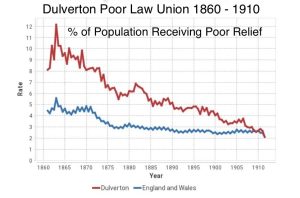
The graph below shows that those receiving poor relief in the eleven Dulverton Union parishes jumped from 8% of the population to over 12% in the 1860s, before falling steadily down to meet the national average at 2%, just before the First World War.
The 1860s were the time of the Lancashire Cotton Famine, when the American Civil War halted the export of cotton, bringing economic depression to the wider world.
In the 1870s, the National Poor Law officials led a Crusade Against Outdoor Poor Relief against the higher numbers on poor relief, applying the Workhouse Test – the poor could only receive poor relief in a workhouse.
In London and Lancashire, 60% of those receiving poor relief were in workhouses, including the majority of elderly male paupers.
But the South West region resisted the Crusade, sending only 20% of all claimants to the workhouse. Three quarters of the impoverished elderly avoided the workhouse.
It is hard to conceive how claimant levels could fall as low as 2% by the end of the nineteenth century. In the Dulverton Union in July 1911, just 102 received poor relief, 22 of whom were in Dulverton Workhouse. Wages were rising and food prices falling. Poor agricultural labourers were moving to the industrial towns. But many remained on the verge of poverty, receiving help from family, charities and the new Friendly Societies.